
Traditionally, high-volume low-mix production has been considered the best way to achieve optimal efficiency and quality. However, for many manufacturers in the United States, meeting customer requirements mean dealing with high-variation/low-volume environments.
High-mix approaches can offer advantages such as, better tailoring to specific customer demand, improved responsiveness to changing market demands and lower finished goods inventories. However, high-mix has traditionally been less efficient because of the inherent variations.
Some of the key challenges of high-mix production include:
- Dealing with more frequent changeover of production set-ups
- Maintaining high quality levels across a mix of configurations
- Potentially more complex logistics for managing piece-part inventories
A key to success with high-mix environments is to minimize these inherent downsides by leveraging configurable interconnect technologies in order to maximize the benefits of being able to offer a wider range of options from within the same production environment.

Manufacturers then need the flexibility to leverage these broad-based and industry focused standards within application-specific parameters for their products and production environments. These include such things as the number of pins in each header, number of rows, press-fit diameters, tail lengths for through-hole pins, Solder Bearing Lead characteristics, stand-off heights, etc.
To support these needs, interconnect vendors must design their product families with the built-in configuration flexibility to define a variety of application-specific part parameters, such as Number of Rows, Positions per Row, Post Height, Mating Zone Length, etc.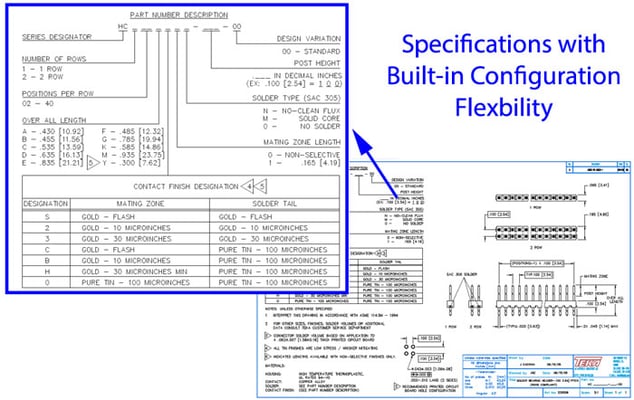
By building standards-based product families around a comprehensive and inherently flexible design methodology, interconnect vendors can quickly and cost-effectively provide manufacturers with tailored application-specific solutions that meet high-mix requirements while also delivering the consistent quality demanded by the prevailing standards.
To learn more, Download the Tech Bulletin on Advanced Interconnect Designs for High-Mix Production.


