
Amid the continuing changes and evolution of module designs in the automotive, power, industrial, motor, and other markets, one thing remains true: busbars still form the backbone for conducting significant current levels within and between assemblies.
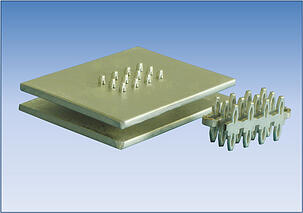 However, as power applications are becoming smaller, faster and more complex, the integration of busbar functionality is undergoing significant evolution as well.
The keys to success are:
- Minimizing contact resistance
- Assuring lifecycle thermal performance
- Reducing product size
- Ensuring power efficiency
- Streamlining assembly and lowering costs
Busbars typically consist of a strip, a bar or sometimes a tube made of copper, brass or aluminum optimized for the particular application’s current requirements and performance specifications. While busbars primarily perform electrical rather than structural functions, designers always need to consider how busbars mesh within the form factor constraints as well as the heat dissipation parameters.
Copper bus systems like the DC-link bus systems in inverter assemblies maximize high current transmission, minimize power losses and provide a high level of heat transfer. However, connecting the busbar systems to either components like DC-link capacitors or to the input of the power module has, up until recently, been a difficult process. The conventional methods used in larger power applications, such as bolting, welding, or clamping connections to busbars, are not always feasible as new-gen power applications get smaller and more complex.
The latest testing results with high-force solderless press-fit interconnects have shown them to be an excellent alternative for new-gen busbar assembly. Previously there was a misconception with some in the industry that copper creep at high temperatures could potentially degrade the interface.
However, extensive high-temperature testing, including accelerated creep testing have now confirmed the extended lifecycle robustness of high-force press-fit to copper busbar interfaces.
To read more and see the details on test results, download the Tech Bulletin on Busbar Connectivity and Integration.


