
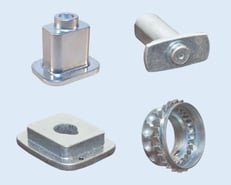
 Cold forging is basically an “impact forming” process that deforms a piece of raw material plastically, under high compressive force, between a punch and a die using suitable equipment such as a machine press.
Compared with other competing technologies, such as machining, die casting, plastic injection molding, weldments, and metal injection molding (MIM), cold forging creates products with a higher impact strength, a higher structural integrity, and better accuracy while using less material. The process is highly productive and optimal for surface finishing.
In essence, it is a displacement process that forms the existing material into the desired shape as compared with conventional machining, which uses a removal process to take away material to create the desired shape.
Understanding the trade-offs and selecting a partner with deep experience in cold forging applications, including vertical integration with other processes, can offer designers and production engineers a valuable alternative to conventional machining or casting processes.
The key to success is to start early in the design process and to consider overall production volume and ramp-up requirements so that cold forging can be leveraged for optimal ROI and quality results.
That is why Interplex has recently published a new Tech Bulletin on Cold Forging Key Advantages.
As first in a series of informative pieces on the topic, it will be followed by several other detailed Tech Bulletins on specific applications, best practices and comparisons with other approaches.
Some of the key benefits covered in this first Tech Bulletin include:
• Higher Productivity for High-volumes
• Material Savings and Cost Reduction
• Improved Part Integrity and Strength
• Enhanced Appearance and Surface Finishing


