
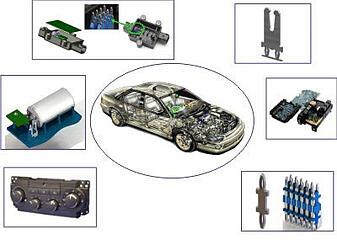
 For over 50 years a variety of Press-Fit connectors have been widely used in the telecom and industrial markets. The technology available for those markets works well in most controlled environment applications where mobility, vibration and harsh environmental conditions are not encountered.
The ongoing development of electronic systems for use in such applications as automotive and transportation systems and green power applications requires the units to operate under quite aggressive conditions and severe ambient environments. Over recent years, there have been several significant design upgrades and changes to past press-fit designs that were needed to move the technology to support these harsher environments.
Some key factors that make Press-Fit technology a popular interconnect component include:
- Press-Fit Technology can reduce or eliminate the need to perform secondary solder operations on PCB assemblies. Not only does this reduce labor and work-in-process, it removes an extra heat cycle that can degrade existing components on the board, and it reduces the amount of solder used in the assembly.
- The press-fit joint is not subject to quality problems associated with solder such as cold spots, voids, splatter and cracks. Press-fit joints are highly reliable.
- Press-Fit parts can be readily customized to enable package designers to meet their envelope and manufacturability targets.
- Material costs can be reduced when compared to pin and socket interconnects.
- The high strength of the press-fit joint eliminates the fretting risk associated with pin and socket
interconnects. Precious metals are not required. - Press-Fit Technology is RoHS compliant
Design upgrades for harsh environments have included:
- Stronger beam designs with increased coining to help with retention but maintain reduced insertion forces.
- Introduction of alloys such as CuNiSi for higher operating temperatures and added conductivity.
- Improved platings for example, thin tin in the press fit sections as well as Ag and SnAg options.
Extensive testing has proven these new press-fit technologies to meet and exceed requirements for harsh environments. Some of the specific testing and certification parameters have included: Mechanical Force Analysis, Contact Resistance Analysis, Cross-Sectioning, and Current-carrying Capacity Testing.
To learn more, download the full Whitepaper on Adapting Press-Fit for Harsh Environments.


