
In conventional soldering processes, the two metal components to be joined are first brought into position and mechanically held in place. Then flux and solder are applied to the conjoined parts, typically by a dipping process.
The biggest issue is the inability of the solder dipping process to consistently assure precise and complete coverage of the desired areas on the pad and contact, which can result in variances of solder joint quality and reliability. In addition, this multi-step soldering process adds cost, time and complexity to the production environment.
In contrast, by including a precise amount of preformed solder and flux on the contact surfaces of a claw shaped design, it is possible to derive 100 percent solderability and consistent repeatability. This is particularly helpful for implementing edge clip connections.
The claws within each contact head can precisely clamp the solder in place to assure correct positioning both before and during the reflow soldering process. This unique grip approach provides direct contact between the solder and conductor pads, thus enhancing correct mechanical positioning and assuring consisent reflow results.
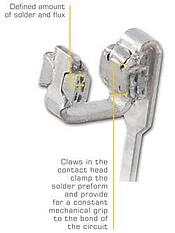
With flexible manufacturing capabilities for adapting the claw design into a widening range of configurations, these yield advantages can be cost-effectively deployed across a broad spectrum of application requirements.
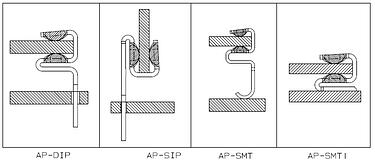
The availability of semi-automatic and high-speed SIP, DIP and Quad lead attachment equipment also enables integration of the solder-bearing edge clips into virtually any set of production requirements, from relatively low-volume flexible-configuration assembly to high-volume automated production environments.
For more information, read the Tech Bulletin on Solder-Bearing Claw Technology


