
The Air Cavity Package (ACP) is a widely used option for RF products, hybrid circuit assemblies, as well as optical/photonic devices. Typical ACP’s have consisted of metal cans and ceramic leadless chip carriers (LCC). Custom ACP’s are also provided by machined metal housings and LTCC options.
However, over the past 10 - 15 years, the development of MEMS Sensors and LED devices has seen the use of thermoplastic pre-molded leadframe packages become the top choice for custom application specific housings. These products are now maturing and moving to “standard” package outlines where possible.
Liquid Crystal Polymers (LCP) are the choice for plastic body components and connectors, developed to suit temperatures of 300 degrees C and above. This means that packages made with such materials can withstand the typical reflow soldering processes used in high-volume system manufacturing.
Following are some key considerations for achieving success with LCP based packaging.
Liquid Crystal Polymer (LCP) has become the preferred engineering plastic for precision components that require high dynamic stability, good moisture resistance and resistance to deformation at high temperatures because LCP offers these key advantages:
- high melt flow, easily fills long, thin, complicated flow paths with minimal warpage
- heat resistant up to +340°C
- very good mechanical strength, toughness
- excellent dimensional stability
- fast cycling
- inherently flame retardant
- excellent organic solvent resistance
- wide processing window
- flash-free manufacturing
Accelerated by the development of sensors and medical MEMs devices as well as the need to get cost out RF type devices for use in wireless and broadband applications, low cost and cavity packaging are now the targets of both the RF applications and the MEMS sensor communities. The package element is often up to 80% of the device cost, so the need for cavity, low cost, plastic options is driving innovation.
For plastic ACP devices, a pre-plated leadframe is the ideal choice, but the temperature performance of LCP is now such that post plating can also be considered as a viable option. This has advantages of allowing copper wirebonding to be used and for treated copper interconnection leads to have an improved adhesion to the LCP materials thereby giving a better seal.
The downside to this approach is both the limitation to the plating options and the additional after assembly provision of a plating process. Reel-to-reel high speed plating lines ensure minimized cost and can offer tight tolerance selective plating of stripe, spot or depth controlled with selective systems.
MEMS Applications
MEMS pressure sensors are of the driver components requiring ACP and utilizing pre-molded leadframes. These are still pushing the market and the engineering capabilities to incorporate a sensor with control and monitoring components into the same package as the connectors. It is typically no longer a box, but is application dependent and, because it is an injection molded part, it can have added features such as
manifolds, attachment points, bolt holes and mounting features, as well as a built-in connector. Automotive
types in particular are becoming sophisticated packaged plug and play modules. LCP is very important here as it has high withstand temperatures enabling mounting of sensors on engine manifolds and in exhaust systems where operating temperatures above 200 degrees C are endured.
RF Applications
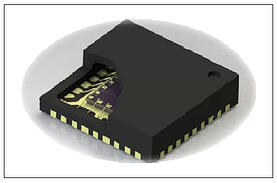
LCP materials are now also widely used for RF circuit substrates. As LCP film is a thermally stable thermoplastic material with a low dielectric constant of 2.9 at 10 GHz with negligible moisture effects, it is used as flexible circuit-board materials for applications from audio frequencies to well past 40 GHz. The Glass filled LCP materials used for injection molding exhibit a number of similar properties and ACP QFN package housings using copper leadframes and a pre-mold LCP base and wall have been proven to give excellent performance in applications at frequencies > 20GHz.
The QFN type LCP packages offer good thermal expansion match to laminate circuit boards and by employing gold plated copper lead frames, high thermal dissipation can be achieved. The material stability allows circuit matching to be designed that will, in many cases of RF component products, enhance the performance of the devices.
For more information, download the Whitepaper on Using LCP for RF and MEMS Packaging Applications


