Interplex Junction - The Place to Connect

Cold Forging Improves Production Efficiency for Drivetrain Components

Posted by Cold Forging Team

Sep 23, 2017 10:53:29 AM

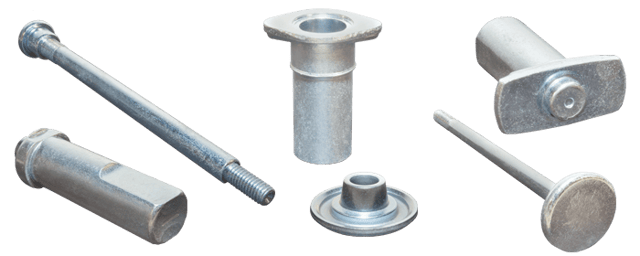
Cold Forging is an "impact forming" process that deforms a billet of raw material plastically, under high compressive force, between a punch and a die using a Horizontal or Vertical Cold Forging press. 

Cold Forging efficiently forms all the existing material into the desired shape thereby maximizing material utilization; whereas Volume-In (billet) = Volume-Out (product). It also greatly increases production throughput rates compared to other manufacturing methods - this can be over 100 times faster in some instances.

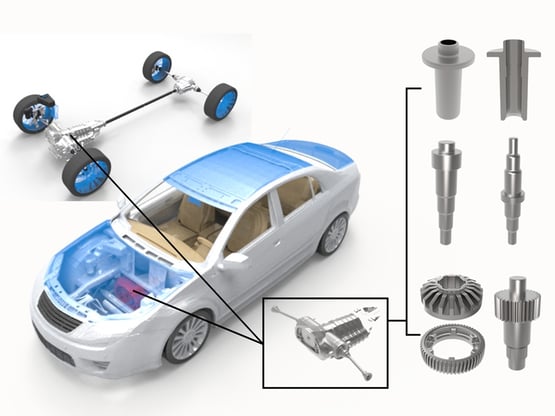
Drivetrain components must endure very high forces (torque, coupling, internal pressures, etc.) and handle instantaneous changes in force over the lifetime of the vehicle. Also, the ever-increasing complexity of the drivetrain component design, is creating new manufacturing challenges.

For creating automotive drivetrain components, Cold Forging offers the following advantages:

  • Improved Strength and Component Integrity
  • Higher Material Utilization Rates
  • Cost-Efficient High-Volume Production

This new Tech Bulletin details the advantages that Cold Forging provides for makers of various critical high-strength components used throughout automotive drivetrains. 

Click here to download the Tech Bulletin.
 

drivetrain.jpg

Read More

Topics: automotive, cold forging

Optimizing Interconnects in Diagnostic Test Strips for Medical Devices

Posted by Interplex Medical Design Team

Oct 31, 2016 5:02:21 PM

Led by sales of glucose monitoring devices, the In Vitro Diagnostics testing segment has rapidly become one of the prominent sectors in the overall Life Sciences & Medical industry.  

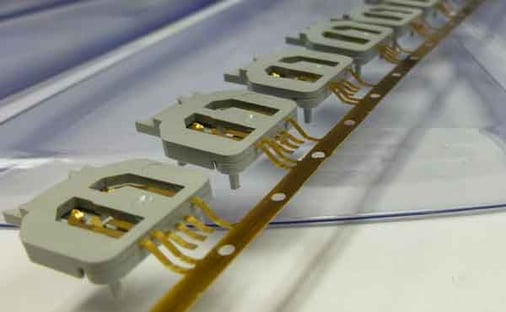
Due to the disposable nature of the diagnostic test strips employed by these medical devices, the interfacing interconnects that read the strips represent a significant technical challenge for achieving volume production levels, stringent quality control requirements and low-cost assembly objectives.

ADC4.jpg


The new Interplex Tech Bulletin on this issue outlines the basics of test strip interconnect design and shows how advanced manufacturing methods combine continuously stamped leads, reel-to-reel over-molding, fully-automated inspection and assembly to enable cost-effective high volume production of interconnects.

Key topics include:

  • Test Strip Design Basics
  • Component Design and Continuous Manufacturing
  • Continuous Automated Assembly and Inspection

To learn more download the Medical Test Strip Technology Bulletin.

Optimizing Interconnects In Vitro Diagnostic Devices

Read More

Reel-to-Reel Chemical Etching - Micro features and tight tolerances

Posted by Etch Logic

Sep 9, 2016 9:37:00 AM

Sometimes an application requires ultra-fine micro features and tolerances that cannot be achieved with even the best controlled metal stamping process.  That is where chemical etching comes into play, with the ability to create highly-repeatable, burr-free components with complex features as small as 1.2x of the material thickness.

Using a tightly-controlled reel-to-reel process enables these micro-features and intricate metal designs or shapes to be produced on a continuous metal strip using a wide variety of ferrous and non-ferrous materials, thereby facilitating the use of reeled components within automated production environments.

Etch_Home_Page_Image

Read More

Topics: chemical etching

Learn the Advanatages of Cold Forging vs. Traditional Machining Processes

Posted by Cold Forging Team

Aug 17, 2016 9:55:00 AM

Cold forging is a displacement process that forms the existing material into the desired shape whereas conventional machining uses a removal process to take away material in order to create the desired shape.

ColdForgedParts.png

Read More

Topics: cold forging

Precision Stamping & Forming Processes for Ultra-thin Materials

Posted by Interplex Stamping Team

Jun 15, 2016 8:38:00 AM

Over multiple decades of evolution, precision metal stamping processes have been repeatedly refined and expanded to encompass a wide range of tight-tolerance, close-pitch, high-precision and light-gauge metal components as well as thicker gauge, larger metal components and assemblies. However, ultra-thin foil material continues to present special challenges that go beyond mainstream stamping technologies.

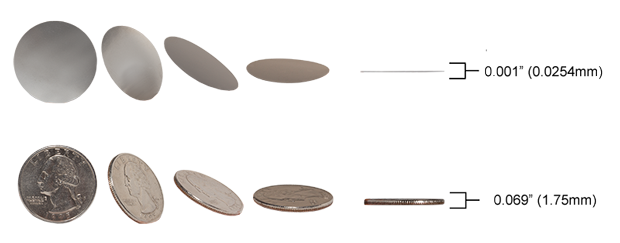
These applications often must be controlled to the millionth of an inch, while taking into account special material characteristics, tooling concerns and consistent process control for high-volume production. Ultra-small Dimensions and Tolerances With ultra-thin foil applications, the geometries of tolerances and material-to-die clearances can quickly become exponentially challenging. For example, assuming a cutting clearance of 10 percent, when stamping material with a 0.001” (0.0254mm) thickness the punch-to-die cutting clearance would be 0.0001” (0.00254).

Thincomparison3.png 

With ultra-thin foil applications, the geometries of tolerances and material-to-die clearances can quickly become exponentially challenging. For example, assuming a cutting clearance of 10 percent, when stamping material with a 0.001” (0.0254mm) thickness the punch-to-die cutting clearance would be 0.0001” (0.00254).

To learn more about the challenges and key process control issues involved with metal stamping and forming ultra-thin materials, read the new tech bulletin.

Ultra-Thin Metal Stamping

Read More

Topics: precision metal stamping

Insert Molding for Plastic Modules in Electronics, Sensors and Medical

Posted by Insert Molding Team

May 18, 2016 7:35:00 PM

Insert molding is an integrated process in which thermoplastic injection encapsulates a part, often a metal stamping, to create a discrete component that combines structural elements and environmental protection with specific embedded interconnect functionality.

There are several applications that naturally benefit from insert molding. These include electronic modules, sensors and medical devices in which there is an internal electronic circuit or other part that has to interface with the outside world.

The key challenge is to make the packaging watertight and structurally robust to protect the internal circuitry from damage, while simultaneously providing electrically reliable connections to the outside circuitry. 

InsertMoldedPart-1

Read More

Topics: insert-molding

Advanced Interconnect Designs are Key to Success in High-Mix Production

Posted by Interplex Industries

Mar 17, 2016 10:25:01 AM

Traditionally, high-volume low-mix production has been considered the best way to achieve optimal efficiency and quality. However, for many manufacturers in the United States, meeting customer requirements mean dealing with high-variation/low-volume environments.

High-mix approaches can offer advantages such as, better tailoring to specific customer demand, improved responsiveness to changing market demands and lower finished goods inventories. However, high-mix has traditionally been less efficient because of the inherent variations.

Some of the key challenges of high-mix production include:

  • Dealing with more frequent changeover of production set-ups
  • Maintaining high quality levels across a mix of configurations
  • Potentially more complex logistics for managing piece-part inventories

A key to success with high-mix environments is to minimize these inherent downsides by leveraging configurable interconnect technologies in order to maximize the benefits of being able to offer a wider range of options from within the same production environment.

interconnects.jpg

Read More

Topics: high-mix, interconnects

How Chemical Etching Creates Fine-Mesh Strength for Fluid Filtration

Posted by Etch Logic

Oct 30, 2015 10:13:47 AM

The requirements to remove smaller and smaller particulates from advanced fluid filtration systems grow larger and larger by the day. 

Fluid Conditioning is the process by which particulates are removed from fluid in a system. Damage happens when key filtration points are ignored. It is the job of the filter to remove these particles from the flow to help prevent premature component wear and system failure. As the sophistication of systems increases, the need for reliable filtration protection becomes ever more critical.

Chemical metal etching is a subtractive manufacturing process that uses baths of temperature-regulated chemicals to remove metal for fine feature creation.  Reel-to-reel chemical etching is a highly controlled, high-volume process that delivers consistency, repeatability and cost effective production.

Read More

Cold Forging Offers Higher Productivity and Strength with Lower Cost

Posted by Cold Forging Team

Sep 29, 2015 10:42:51 AM

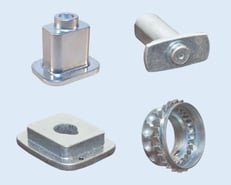
cold-forging-samples-blueCold forging is basically an “impact forming” process that deforms a piece of raw material plastically, under high compressive force, between a punch and a die using suitable equipment such as a machine press.
Compared with other competing technologies, such as machining, die casting, plastic injection molding, weldments, and metal injection molding (MIM), cold forging creates products with a higher impact strength, a higher structural integrity, and better accuracy while using less material. The process is highly productive and optimal for surface finishing.

Read More

Topics: cold forging

Visit Interplex at Electric & Hybrid Tech Show

Posted by Power Products Design Team

Aug 27, 2015 10:14:00 AM

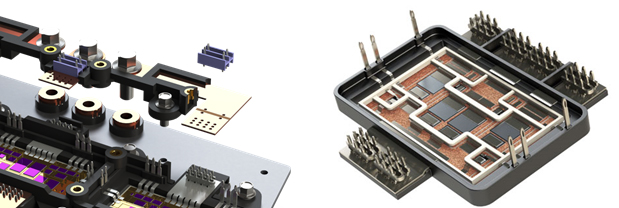
Visit Interplex at  the Electric & Hybrid Tech Expo in Novi, Michigan, September 15-17, 2015 (Booth #929) to learn how Interplex's power module packaging solutions create high levels of inverter efficiency.

We leverage our knowledge of interconnect technology, especially our press-fit technology, to create application-specific power module interconnect solutions, power module integration systems and IGBT power module packaging solutions to meet the demanding needs of the electric and hybrid vehicle market.
 
Read More

Topics: module design & manufacturing, automotive, power applications