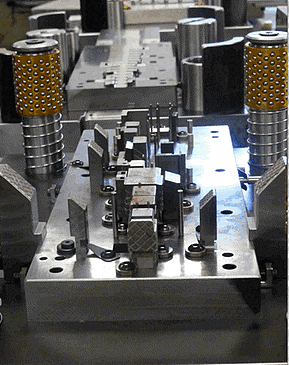
Over multiple decades of evolution, precision metal stamping processes have been repeatedly refined and expanded to encompass a wide range of tight-tolerance, close-pitch, high-precision and light-gauge metal components as well as thicker gauge, larger metal components and assemblies. However, ultra-thin foil material continues to present special challenges that go beyond mainstream stamping technologies.
These applications often must be controlled to the millionth of an inch, while taking into account special material characteristics, tooling concerns and consistent process control for high-volume production. Ultra-small Dimensions and Tolerances With ultra-thin foil applications, the geometries of tolerances and material-to-die clearances can quickly become exponentially challenging. For example, assuming a cutting clearance of 10 percent, when stamping material with a 0.001” (0.0254mm) thickness the punch-to-die cutting clearance would be 0.0001” (0.00254).
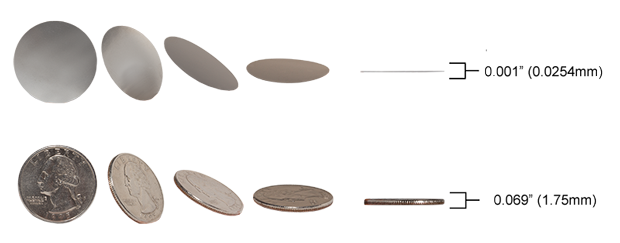
With ultra-thin foil applications, the geometries of tolerances and material-to-die clearances can quickly become exponentially challenging. For example, assuming a cutting clearance of 10 percent, when stamping material with a 0.001” (0.0254mm) thickness the punch-to-die cutting clearance would be 0.0001” (0.00254).
To learn more about the challenges and key process control issues involved with metal stamping and forming ultra-thin materials, read the new tech bulletin.